Radio Wave Propagation(Propagasi gelombang radio) mendefininasikan kelakuan-kelakuan atau cara-cara sesuatu gelombang radio bergerak dalam ruang kosong(free space).
Cara-caranya ialah:
1) Aurora Propagation
2) Back Scatter
3) Blind Zone(Skip Zone)
4) Sporadic-E
5) F2
6) Gray-line
7) Meteor Scatter
8) Line Of Sight
9) Trans-Atlantic
10) Trans-Equatorial Propagation
11) Tropospheric Scatter
12) Ducting
Jauhnya atau dekat sesuatu gelombang bergerak sangat bergantung kepada lapisan-lapisan ION di lapisan atmosfera bumi. Lapisan-lapisan ini dipanggil lapisan Ionosphere.
Introduction to HF Propagation
Cara-caranya ialah:
1) Aurora Propagation
2) Back Scatter
3) Blind Zone(Skip Zone)
4) Sporadic-E
5) F2
6) Gray-line
7) Meteor Scatter
8) Line Of Sight
9) Trans-Atlantic
10) Trans-Equatorial Propagation
11) Tropospheric Scatter
12) Ducting
Jauhnya atau dekat sesuatu gelombang bergerak sangat bergantung kepada lapisan-lapisan ION di lapisan atmosfera bumi. Lapisan-lapisan ini dipanggil lapisan Ionosphere.
Introduction to HF Propagation
In a region extending from a height of about 50 km to over 500 km, some of the molecules of the atmosphere are ionised by radiation from the Sun to produce an ionised gas. This region is called the ionosphere.Ionisation is the process in which electrons, which are negatively charged, are removed from (or attached to) neutral atoms or molecules to form positively (or negatively) charged ions and free electrons. It is the ions that give their name to the ionosphere, but it is the much lighter and more freely moving electrons which are important in terms of high frequency (HF: 3 to 30 MHz) radio propagation.
Generally, the greater the number of electrons, the higher the frequencies that can be used. During the day there may be four regions present called the D, E, F1 and F2 regions.
Their approximate height ranges are:
D region 50 to 90 km;
E region 90 to 140 km;
F1 region 140 to 210 km;
F2 region over 210 km.
During the daytime, sporadic E is sometimes observed in the E region, and at certain times during the solar cycle the F1 region may not be distinct from the F2 region but merge to form an F region. At night the D, E and F1 regions become very much depleted of free electrons, leaving only the F2 region available for communications; however it is not uncommon for sporadic E to occur at night.Only the E, F1, sporadic E when present, and F2 regions refract HF waves. The D region is important though, because while it does not refract HF radio waves, it does absorb or attenuate them.
The F2 region is the most important region for high frequency radio propagation as, it is present 24 hours of the day. Its high altitude allows the longest communication paths, it usually refracts the highest frequencies in the HF range.The lifetime of electrons is greatest in the F2 region which is one reason why it is present at night. Typical lifetimes of electrons in the E, F1 and F2 regions are 20 seconds, 1 minute and 20 minutes, respectively.
The intensity of the Ionosphere depends on the sunspot activities on the surface of the sun. Every sunspot cycle is 11 years.
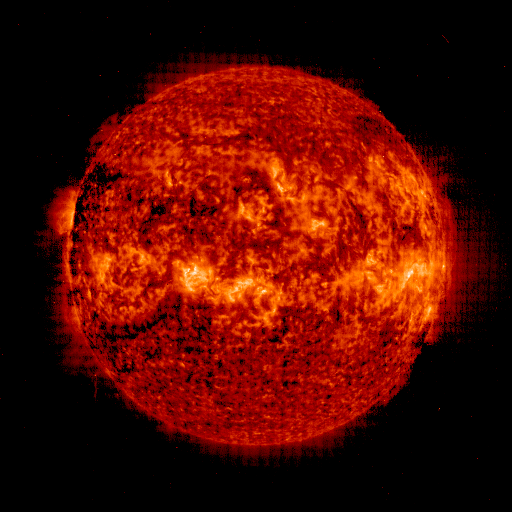
Latest full-field Solar Images These images are current views of the sun shown at different wavelengths of light as taken by SOHO and the Yohkoh soft-Xray telescope.

Fe IX/X 171 Å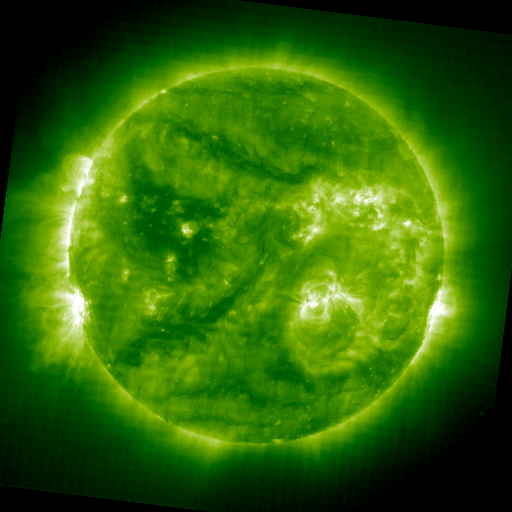 Fe XII 195 Å
Generally, more bright regions on the disk indicates more solar activity, which usually leads to higher solar flux levels (which usually leads to better propagation!).
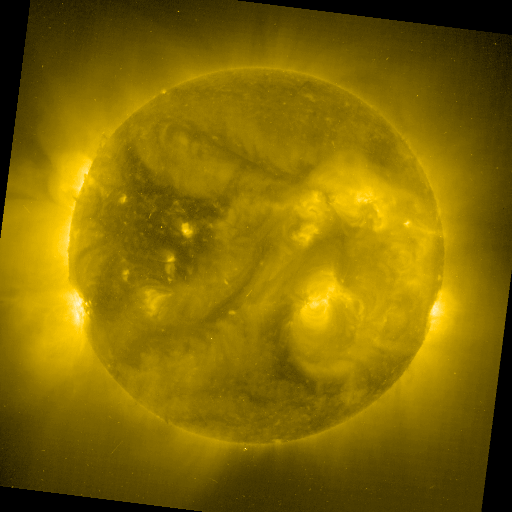
Fe XV 284 Å
Aurora is caused by interaction between the Earth's magnetic field and the solar wind (a mix of charged particles blowing away from the sun). During solar storms, enough of these charged particles make it through to the Earth's upper atmosphere that they interact with the earths natural magnetic field lines. When enough of these particles collide, energy is released in the form of auroral light. In addition to creating a pretty light show (mostly in upper latitudes), radio signals scatter off of these particles and can greatly enhance propagation on 6 meters and above. High levels of aurora can also make propagation via polar routes difficult.
Solar X-ray Flux
This plot shows 3-days of 5-minute solar x-ray flux values measured on the SWPC primary and secondary GOES satellites. One low value may appear prior to eclipse periods. Click on the plot to open an updating secondary window
This plot shows 3-days of 5-minute solar x-ray flux values measured on the SWPC primary and secondary GOES satellites. One low value may appear prior to eclipse periods. Click on the plot to open an updating secondary window

D-Region Absorption Prediction Map
This images dynamically updates once a minute. specially designed by NOAA National Weather and Space Service Prediction Center. for HF Radio communications prediction. Click on any thumbnail to view a larger image.
This images dynamically updates once a minute. specially designed by NOAA National Weather and Space Service Prediction Center. for HF Radio communications prediction. Click on any thumbnail to view a larger image.


Real-Time Northern Hemisphere Auroral Activity
 Real-Time Southern Hemisphere Auroral Activity
Taken from GlobalTuners for RAE Study.

No comments:
Post a Comment